
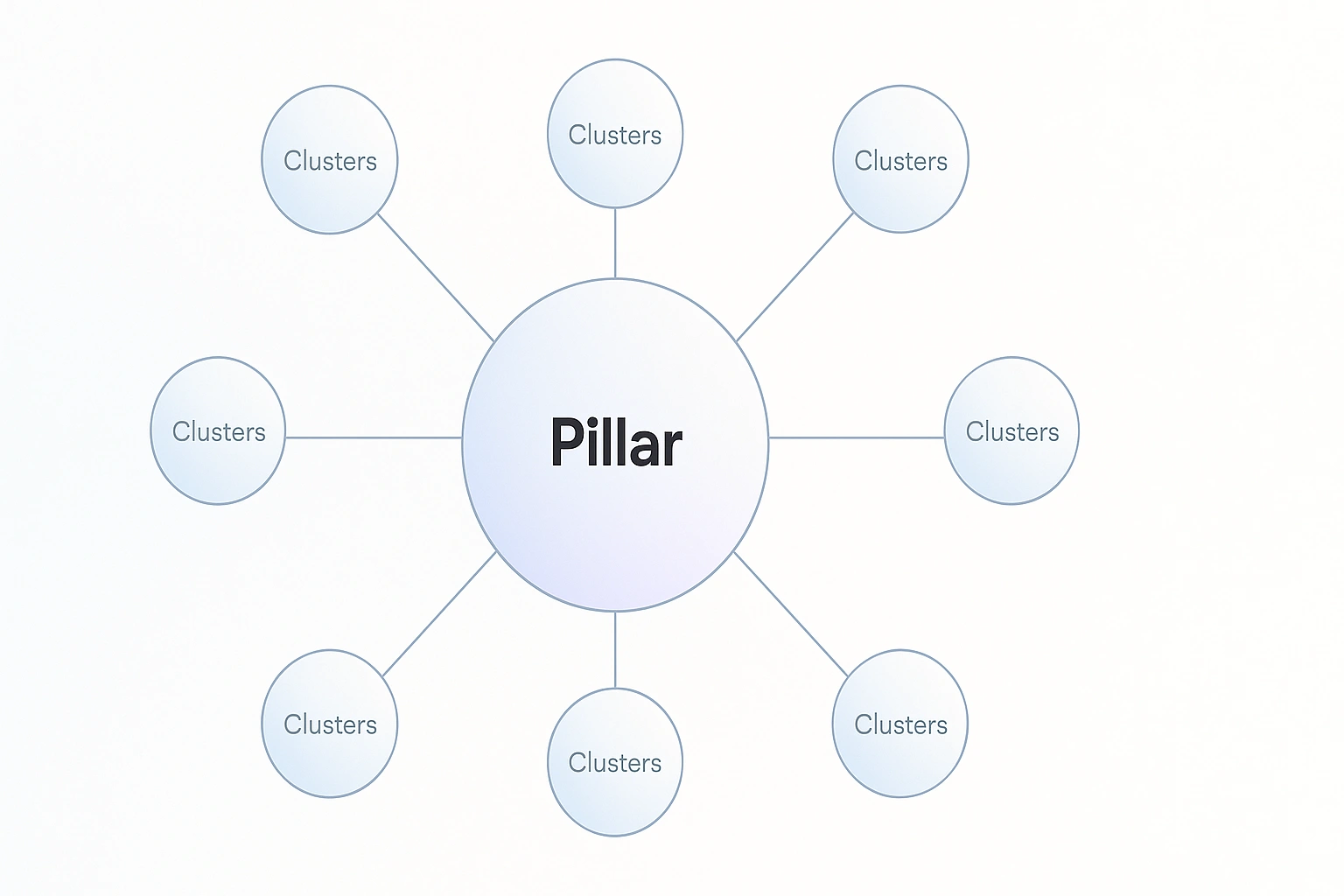
Most blogs fail because they publish random posts. This pillar–cluster strategy shows you precisely what to publish, how to interlink it, and how to promote it—so your new blog ranks in ~90 days and converts readers into leads.
Quick Summary (for busy readers)
- Pillar post: 1 broad, definitive guide (2,500–4,000 words).
- Cluster posts: 8–12 focused articles (800–1,800 words) that answer sub-questions.
- Linking: Every Cluster → pillar (exact/partial-match anchors). Pillar → all clusters (contextual).
- Cadence (90 days): Ship 2 pillars + 10 clusters, promote weekly, iterate monthly.
- Outcome: Topical authority, stronger UX, faster rankings, clearer conversions.
1) Why Most Blogs Don’t Rank (and How Pillar–Cluster Fixes It)
Common failure modes:
- Random topics; no topical depth
- Weak internal linking (Google can’t read the structure)
- Short, shallow posts that miss search intent
- No promotion; no updates
Pillar–Cluster solves this with:
- Coverage: You answer the entire topic comprehensively.
- Structure: Clean URL architecture + clear internal links.
- Intent match: Pillar for breadth; clusters for specific needs.
- Signals: Consistent updates, interlinks, and engagement.
2) Pillar vs. Cluster — Clear Definitions
- Pillar: The “master guide” that organizes a topic, links out to clusters, and targets a broad keyphrase (e.g., “spine health guide”, “start a blog”).
- Cluster: Specific subtopics that support the pillar (e.g., “lower-back pain exercises”, “SEO checklist for new blogs”).
Ideal counts for a new site (first 90 days):
- 2 pillars (2,500–4,000 words each)
- 10 clusters (5 per pillar)
3) Pick Your Topic Like a Pro (with examples)
Choose 1–2 core topics you want to be known for. Make sure each topic has profit potential (services, products, lead magnets).
Example A — Spine & Orthopaedics (medical niche)
- Pillar: Spine Health 101: Symptoms, Diagnosis, Treatments & Recovery
- Clusters:
- Lower back pain exercises (at home)
- Sciatica vs herniated disc (differences)
- When to see a spine specialist (red flags)
- MRI vs X-ray for back pain (patient guide)
- Posture & ergonomics for desk workers
- Minimally invasive spine surgery (overview)
- Post-op spine care: week-by-week
- Physical therapy for spinal stenosis
- Scoliosis basics for adults
- Pain management options (patient-safe)
Medical safety: Add a disclaimer on every medical page: “Educational only, not medical advice.”
Example B — Writing & Blogging
- Pillar: Start a Blog in 2025: Complete Guide (Strategy, SEO, Monetization)
- Clusters: domains & hosting, pillar–cluster basics, editorial calendar, SEO checklist, internal linking, featured snippets, affiliate disclosure, site speed, schema basics, content updates
Example C — AI & Tech
- Pillar: AI Content Systems for Small Teams
- Clusters: brief generator, meeting notes to actions, CMS formatter, content repurposing, KPI dashboard, invoice reminders, CRM enrichment, support replies, security hygiene, editorial QA
4) 90-Day Roadmap (Week-by-Week)
Days 1–7: Map Your Topic + Keywords
- Select two pillar topics related to your services.
- Brainstorm 10–20 clusters total.
- Draft a Topic Map (see template below).
- Gather seed keywords (Google Autocomplete, People Also Ask, GSC if any).
- Shortlist one pillar + 5 clusters for Phase 1.
Days 8–14: Outlines + Briefs
- Create 1 pillar outline + 5 cluster outlines (H2/H3s, FAQs, intent).
- Prepare internal link plan (which page links to which).
- Assign CTAs (newsletter, service page).
Days 15–30: Publish 1 Pillar + 5 Clusters
- Ship Pillar #1 (2,500–4,000 words).
- Publish 2–3 clusters/week.
- Interlink clusters ↔ pillar; add “Related Reading.”
- Add images/diagrams; alt text + compression.
Days 31–45: Promotion + Second Pillar Outline
- Share every post on LinkedIn/Twitter/Medium (canonical pointing to your site).
- Add posts to 2 community platforms (Reddit, Quora answers where relevant).
- Start guest post pitches that naturally link to your pillar.
- Outline Pillar #2; draft five more clusters.
Days 46–60: Publish 1 Pillar + 5 Clusters (Batch 2)
- Ship Pillar #2 + 5 clusters.
- Update interlinks across the hub.
- Add FAQ schema to clusters; implement breadcrumb schema site-wide.
Days 61–90: Optimize & Earn Links
- Update Pillar #1 with insights from clusters (freshness signal).
- Add internal links from any older posts to new clusters.
- Publish one comparison or data post (easy link bait).
- Continue weekly sharing + two guest posts/month.
- Start a monthly content update sprint (improves rankings fast).
By Day 90, you should have two pillars + 10 clusters live, well-interlinked, and promoted.
5) The Topic Map Template (copy/paste)
Topic (Pillar): Spine Health 101
Primary Intent: Informational (patient-friendly)
Audience: Patients & caregivers
Primary CTA: Book consultation / Contact clinic
Secondary CTA: Download patient checklist (lead magnet)
Clusters (with intent & CTA):
- Lower back pain exercises — Informational — CTA: Download exercise PDF
- Sciatica vs herniated disc — Informational — CTA: Book consult
- When to see a specialist (red flags) — YMYL safety — CTA: Call clinic
- MRI vs X-ray — Informational — CTA: Ask your doctor checklist
- Posture & ergonomics — Practical — CTA: Subscribe for rehab tips
Add status, owner, deadline, and links in/out columns to manage production.
6) Keyword Research: Simple Workflow (15–45 minutes/topic)
- Seed ideas: Write what real people ask you; use People Also Ask.
- Expand: Autocomplete variations; related searches.
- Group by intent: Awareness (what/why), Consideration (how/which), Decision (best/near me).
- Choose one primary keyword per page; list 3–5 variations to use in H2/H3s.
- Reality check: Aim for mixed difficulty—some easy clusters + a few ambitious ones.
Example (Writing & Blogging pillar):
- Primary: “start a blog 2025”
- Variants: “how to start a blog”, “blogging for beginners”, “blog setup checklist”, “blog SEO basics”
7) Content Brief Template (use for every post)
- Page type: Pillar | Cluster
- Primary keyword:
- Search intent: Informational / Commercial / Transactional
- Reader outcome: What should they walk away with?
- Outline (H2/H3): numbered list
- FAQs: 4–6 specific questions
- Internal links to include: 3–5 (pillar/cluster/related)
- External sources (if needed): 2–4 authoritative references
- CTA: exactly what you want next (newsletter, service, download)
8) On-Page SEO & UX Checklist (10-minute pass)
- Single H1; descriptive, includes primary keyword.
- Intro (2–4 lines): promise + who it’s for + why it matters.
- H2/H3 match sub-intents; use keyword variations naturally.
- Use short paragraphs, lists, and tables where helpful; ensure mobile-friendliness.
- Images with alt text, compressed, and meaningful captions if needed.
- FAQ section: consider the FAQ schema on clusters.
- Internal links: 2–5 per 1,000 words; descriptive anchors.
- CTA box (inline or end): clear, relevant, non-pushy.
- Last updated date; author bio for E-E-A-T.
- Medical pages: add educational-only disclaimer.
9) Internal Linking Blueprint (with anchor examples)
Rules:
- Every Cluster → pillar using exact or partial match:
- “See our Spine Health 101 guide for a complete overview.”
- Pillar → clusters contextually:
- “If your pain shoots down the leg, learn more about sciatica vs a herniated disc.”
- Cross-link clusters when closely related:
- From posture to desk ergonomics: “Improve your workspace with ergonomic setup basics.”
- Keep links above the fold where natural; add a Related Reading box mid-post.
Placement targets per page:
- Pillar: link to every Cluster once; 2–3 cross-links among clusters.
- Cluster: link up to pillar once near top; 1–3 cross-links to siblings.
10) Promotion Engine (lightweight but consistent)
Repeat for every post:
- LinkedIn: 5–7 bullet summary + 1 chart/diagram → link in first comment.
- Twitter/X: 4–6 tweet thread (1 idea per tweet).
- Medium: Syndicate with a canonical URL to your site.
- Communities: Answer one relevant question on Reddit/Quora and link to the most helpful section (never spam).
- Newsletter (if you have one): short teaser + “what’s inside” bullets.
Monthly link magnets:
- A data point (poll/survey)
- A comparison (tools, methods)
- A checklist or calculator (downloadable)
11) Tracking & Optimization (what to measure weekly)
Google Search Console (GSC):
- Queries → which H2s to expand
- Pages with impressions but low CTR → improve meta titles/descriptions
- Internal link opportunities → pages that rank page-2/3
Google Analytics:
- Time on page & scroll depth (thin sections? add detail/media)
- Top exit points (add a CTA or “what to read next”)
Editorial metrics:
- New posts/week
- Internal links added/week
- Posts refreshed/updated/month
Simple tracker columns: URL | Type (Pillar/Cluster) | Status | Primary KW | Last Updated | In-Links | Out-Links | Notes
12) Example Pillar & Cluster Outlines (copy these)
Pillar (Writing & Blogging): Start a Blog in 2025
- H2: Choose a niche & purpose
- H2: Set up domain, hosting, CMS
- H2: Site structure (categories, pillar–cluster)
- H2: Essential pages (About, Contact, Policy)
- H2: Content calendar (first 90 days)
- H2: On-page SEO basics
- H2: Internal linking (hub & spoke)
- H2: Promotion + list building
- H2: Monetization options (ads, affiliates, services)
- H2: Maintenance & updates
Cluster (Spine & Ortho): Lower Back Pain Exercises (At Home)
- H2: Safety note (not medical advice)
- H2: When to see a doctor (red flags)
- H2: Gentle warm-up
- H2: 5 exercises (with cues & regressions)
- H2: Daily/weekly plan (progression)
- H2: Ergonomics tips for desk work
- H2: FAQs
- CTA: Download printable routine / Book consultation
13) Content Calendar (first 12 weeks)
Week 1: Pillar #1 outline + Cluster 1
Week 2: Cluster 2, Cluster 3
Week 3: Pillar #1 publish + Cluster 4
Week 4: Cluster 5 + update Pillar #1 with links
Week 5: Promote + Pillar #2 outline
Week 6: Cluster 6, Cluster 7
Week 7: Pillar #2 publish + Cluster 8
Week 8: Cluster 9 + update interlinks
Week 9: Cluster 10 + guest post #1
Week 10: Refresh top 3 posts + “data” post
Week 11: Guest post #2 + internal links pass
Week 12: Review GSC + republish improvements
14) E-E-A-T & Compliance (make trust visible)
- Author bio with headshot, credentials, and real links.
- Editorial policy page (how you research, review, and update).
- Last updated on every page.
- Contact page with working email/socials.
- Medical posts: Disclaimers + accessibility + patient-safe tone.
- Affiliate & privacy disclosures where relevant.
15) Common Mistakes (and how to avoid them)
- Publishing randomly: Always connect clusters to a pillar.
- Too thin: If a subtopic lacks depth, merge it with a sibling.
- Keyword stuffing: Write for humans; use variations naturally.
- No updates: Refresh winners quarterly; prune losers.
- Ignoring intent: Matching content to what searchers actually want (guides, checklists, and comparisons).
16) What to Do Next
- Choose one pillar topic tied to your services.
- Map 5 clusters and write the briefs.
- Publish Pillar #1 + 2–3 clusters in the next two weeks.
- Interlink, promote, and measure on a weekly basis.
Need a done-for-you pillar and cluster plan, plus writing?